
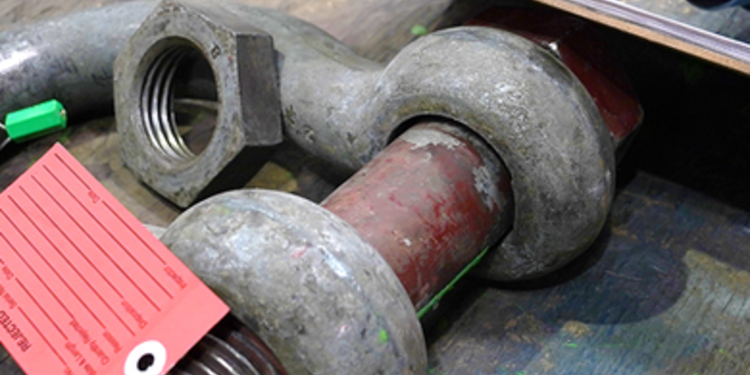
Shackle Inspection 101: 5 Signs You Need to Retire Your Hardware
In industrial rigging, a shackle is the critical link between safety and catastrophe. While steel appears indestructible, repeated stress and environmental exposure eventually take their toll. Use these five technical indicators to determine when your hardware has reached the end of its professional service life.
1. Permanent Deformation and "Neck-Down"
If a shackle body is no longer perfectly symmetrical, it has been compromised. "Necking" occurs when the metal stretches under extreme tension, causing the parallel sides of a Dee shackle or the throat of a Bow shackle to narrow.
The Rule: Any visible twist, bend, or elongation in the body indicates that the steel’s molecular structure has passed its elastic limit. Once the metal is permanently deformed, its rated Working Load Limit (WLL) is no longer valid.
2. The 10% Wear Threshold
Friction is inevitable at the crown (the top of the bow) and on the pin, especially during heavy-duty movement. However, there is a strict limit to how much material loss is acceptable.
The Rule: Use calipers to measure the diameter of the pin and the thickest part of the bow. If the measurement is 10% less than the original factory dimensions, the shackle must be retired. This loss of cross-sectional area directly translates to a loss in lifting capacity.
3. Pin Misalignment and Thread Damage
A safety-compliant pin should seat fully into the shackle ear with smooth, hand-tight precision. If you find yourself reaching for a wrench just to get the pin started, there is an underlying issue.
The Rule: Retire the shackle if the pin is bent, the threads are flattened/cross-threaded, or if the pin shoulder does not sit flush against the ear. A poorly seated pin creates uneven stress distribution, which can lead to the pin "popping" under load.
4. Deep Pitting and Chemical Corrosion
Surface oxidation (light rust) is common, but "pitting" is a structural threat. Pitting appears as small, deep holes that act as stress concentrators where cracks can easily begin to form.
The Rule: If corrosion has moved beyond the surface and created craters or irregular textures in the metal, the shackle is unsafe. For acidic or saltwater environments, always ensure you are using Grade 316 Stainless Steel or properly galvanized alloy to prevent this degradation.
5. Heat Discoloration ("Blueing")
Industrial shackles are heat-treated (quenched and tempered) to achieve their specific strength. Exposure to extreme heat can "anneal" the steel, making it soft and significantly weaker without changing its shape.
The Rule: Inspect the hardware for a "rainbow" or blueish iridescent tint on the surface. This discoloration is a sign of high-heat exposure. If a shackle has been exposed to temperatures exceeding 200°C (or shows signs of weld splatter/arc strikes), it must be scrapped immediately as its internal tempering has been destroyed.